COMPOSITION:
conversations about content & form
  • ABOUT
  • CONTACT
  • ARTEFACTS
    • Re-narrating the city through the presentation of location
    • Cyborg Culture

ARTEFACTS 

Original work/Remix + Commentary/Response
No.2  Cyborg Culture in the writing of Vincent Miller (2011) Donna Haraway (2011) and Ingrid Richardson (2007) remixed by Nigel Painting (2017)
Picture
The original works 

'Most people’s first introduction to the cyborg is within popular media –and particularly science fiction – where the notion of the cyborg has almost always taken on a threatening quality.' (2011: 211-212)....'At the same time, more benign cyborgs in popular media, such as The Six Million Dollar Man or Robocop, portray cyborgs as helpful, as opposed to threatening, but still with a sense of pathos associated with the denigrated human' (2011: 220).

Miller, V. (2011) Chapter 9: The Body and Information Technology, in Understanding Digital Culture. London: Sage.
​
“By the late twentieth century, our time, a mythic time, we are all chimeras, theorized and fabricated hybrids of machine and organism; in short, we are all cyborgs. The cyborg is our ontology; it gives us our politics. The cyborg is a condensed image of both imagination and material reality…”​

Haraway, D. "A Cyborg Manifesto: Science, Technology, and Socialist-Feminism in the Late Twentieth Century," in Simians, Cyborgs and Women: The Reinvention of Nature (New York; Routledge, 1991), pp.149-181.
​

'Mobile media technologies, and tele-technologies more generally, are therefore not simply prosthesis or augmentations of our sensorium, but tools which impact upon our bodily limits, shifting the variable boundaries of embodiment, and altering our sense of having a body: they educe altered ‘involvements’ of the soma' (2007: 207).

Richardson, I. (2007). Pocket Technospaces: the Bodily Incorporation of Mobile Media. Continuum: Journal of Media & Cultural Studies. 21 (2), pp. 205-215
Picture
The remix by Nigel Painting
Picture
Commentary on the remix by Nigel Painting
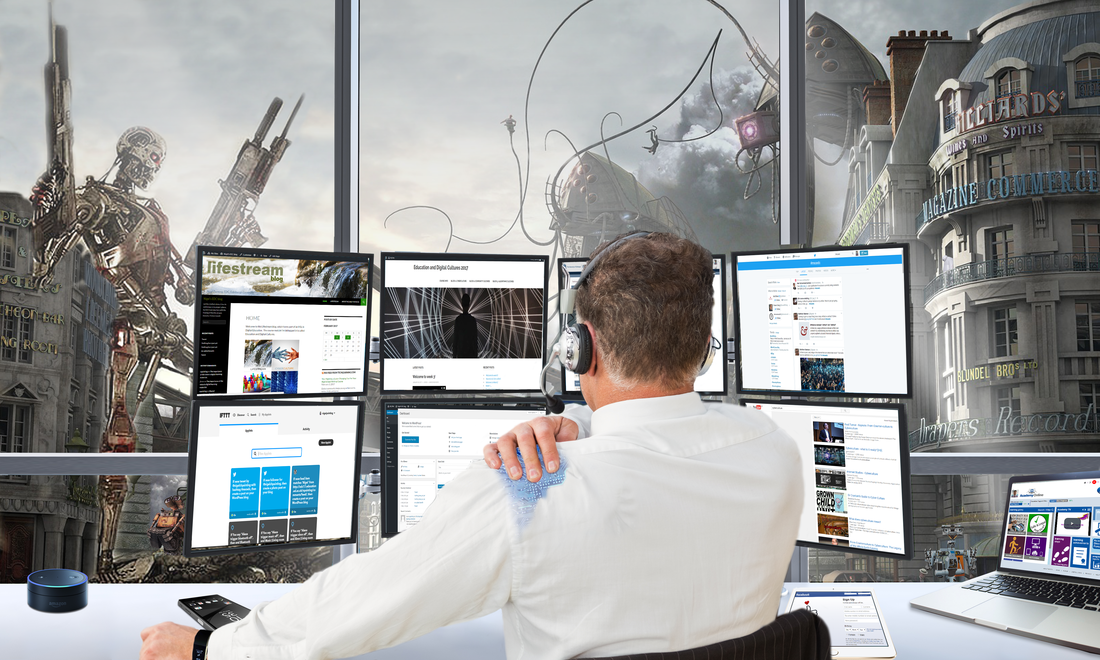
I created this visual artefact to summarise learning themes from the ‘Cybercultures’ block of the Education & Digital Cultures course, part of the MSc in Digital Education at Edinburgh University. The key themes that emerged from studying the course were as follows: sentience; almost human; memory; divisions between technology and humanness; the preservation of the authentic human; the utopia and dystopia of technological intervention; enhancement, and; centring of the desiring human subject. The visual artefact shown above is my attempt at representing as many of these themes as I could, and to hint at points raised in some of the academic discussion on the subject of cyberculture.  

The scene outside the window is a response to first part of the quote from Vincent Miller (2011) above. I wanted to highlight the fact that the representation of cyborgs as evil is not a recent phenomenon: you will see that there are images from several generations, starting with the Tripods (which are not strictly cyborgs as they do not have a human form) to the Terminator.  As Miller points out in the second part of the quote printed above, cyborgs are also sometimes portrayed in the popular media as being helpful to society: the Six Million Dollar Man and Robocop, for instance. With this in mind I included some of the more recent movie characters such as WALL-E, Johnny 5 and Big Hero 6.  All of these stretch the cyborg definition a little but they each have characteristics we would recognise as intrinsically human.

In the foreground of the image I am sat at a workstation surrounded by a plethora of devices that are all connected to the ‘cloud’ and also, one way or another, to my body: directly, such as the headset and the Fitbit; visually, through the array of screens, or; aurally, through devices such as the Echo Dot.  This is my response to the quote from Donna Haraway, taken from here Cyborg Manifesto. The circuitry that can be seen through my shirt is intended to indicate that we are perhaps becoming cyborgs ‘by stealth’, that it is creeping up on us from behind. Whether you see this as a spreading infection or an enhancement will, perhaps, depend on your point of view.  As you can see from the image it is causing me some discomfort, which alludes to my own thoughts on the matter, particularly with devices such as the Echo Dot and their ‘big brother is always listening’ connotations.

Lastly, through the array of screen in the picture I wanted to represent what Vincent Miller refers to as ‘technological embodiment’. This is shown through multiple virtual representations of me, facilitated by the computer mediated communication routes that were used during the Education and Digital Cultures course (such as blog comments and Twitter), though my work, and through my social life (represented as a Facebook page and the Fitbit, which represents me on Runkeeper). These aspects of the picture can be seen as a response to work of Ingrid Richardson where she argues that mobile media technologies need to be conceptualised in ways beyond prosthesis or an augmentation of the senses, and instead to recognise how technologies affect our 'bodily limits' and 'boundaries of embodiment',
Picture
Responses to the remix
by Chris Bailey
​

This is a striking image, and one that has clearly been assembled with some skill! There is so much to see and make sense of between the borders of one relatively small rectangle: I love both the composition and the use of muted, slightly desaturated colour on the other side of the glass. I like how the viewer of the image shares a viewpoint with the central figure (you, as it turns out!), whilst also sneaking a look at his private information on the screens. The image provides a means of representing and playing with multiple concepts all in one go, rather than taking the kind of  linear approach that we might be most familiar with when making critical responses to texts. 

Your commentary is a valuable addition to the remix, helping to convey how you drew out the themes of the quotes in your visual work. I’d add that my own reading of the image, prior to my engagement with the text, forefronted the emotional or emotive aspects of the piece - the menace, stress and urgency of the scene that is pictured, on both sides of the window! 

​I’d guess I would most like to know to what extent the image was a result of your reaction to the quotes, and to what extent your commentary involved you engaging in a reading your own image. Did the construction of the image support you in generating new insights into the topic? Did your own image help, somehow, to mediate your understanding and thoughts on the topic?  (Having worked with images and theory myself I’d hazard a guess that it probably did!) 

Chris Bailey is currently a lecturer in Education at Sheffield Hallam University and a researcher at the University of Leeds
by Hamish MacLeod

From the image itself, the initial impression is of a human under pressure from the world outside. The background images - of Tripods and Terminator, and the canyons of the city, held at bay by the modernist elements of glass and steel - stand as physical and fantastical manifestations of the mental pressures that emanate from the bank of screens. The screens are the immediate mental environment of the person in the image. Superficially relaxed and in control, the posture of the human - right arm stretched (defensively?) across the body, with the right hand responding to massage a stiff shoulder or neck - seems a manifestation of the consequences of the pressure being felt.

At first glance, and because of their arrangement, the array of screens looks much like that which could be seen on a office worker’s desk - perhaps in a financial trading context, or an industrial process control setting, Issues of selective and divided attention come to mind. Although one may be quite envious of the monitor “real estate” this person has access to, and the social standing that such access implies. The commentary clarifies that the screens in fact represent different windows onto the person’s extended cognitive world; that of the personal, social and educational. While these may be experienced serially (in the attentional sense), all are simultaneously present in the back of the mind, or the corner of the eye. One knows that if the demands of one channel could be dealt with, and set aside, another would certainly be there to take its place. This person is clearly integrated - or becoming integrated - into his technological context, but one has to ask whether this integration is wholesome, or entirely consensual.

​The prominent headphones are suggestive of the “upgrade” offered by the Cybermen of the Doctor Who mythos. The human being depicted here looks less like a “user” and more like a “use-ee”. While the commentary speaks of both the Dark and the Light sides of the robot heritage, the Dark seems much more visible in the imagery than does the Light; Jonny 5 and WALL-E are small, and take some finding. These references put me in mind of Isaac Asimov’s stated objective in his robot novels and short stories to rehabilitate the image of the robot, and to present it as being something that could be a positive contributor to the human condition. Mary Shelley’s vision of the artificial would seem to be winning out over that of Ada Lovelace in our present cyber culture. Yet perhaps the strained posture of the figure in the image might reflect only growing pains, as a better balance comes to be struck within Licklider’s promised “symbiosis” as the tool-user becomes the cyborg.

Hamish MacLeod is a Senior Lecturer in Digital Education at the University of Edinburgh
by Katherine Firth

Central to the picture, and yet slightly de-centred to the right, is the back of the artist's head. His slightly greying hair and headphone-microphone wearable technology lead the eye, in a diagonal line, to his white collar shirt and the hand at his shoulder, bleeding blue circuitry. At this point the eye is drawn by three conflicting lines of visual composition. Out of the centre upwards: where a tentacled cyborg grows out the the crown of the artist's head, rampaging though a dust cloud and snatching up smaller human figures.

Out of the centre horizontally: where the square monitors display smaller squares on screen, visually playing against the larger squares of the window frames. And out of the centre diagonally to the left: following the angle of the arm, to the Fitbit, the phone, and from thence the eye skips to the echodot, and back out the window to a strongly drawn visual upward line of a heavily armed skeletal cyborg whose guns mirror, in inverse, the angle of the artist's arm.

The red cyborg eye looks down at something hidden from view by the monitors, possibly something where the street seems to be, following this line of sight draws the viewer’s eye back to the artist's head. A purple 'eye' on the opposite side again reflects that acute angle, with the head as it's apex. Finally the eye moves to the smaller details of the iPad and laptop to the right of the desk, which sit powerfully juxtaposed with the building outside's vintage signage advertising print media magazines, human family business, and comestibles. The art deco building draws the eye up, with the grey roof reflecting the grey sky. 

While the image thus dramatically collages technologies, it prioritises the human body, and particularly the human mind. The artist's head is made central and the lines of the image continually draw the eye back to it. Similarly, the angle of the artist's arm and body is reused and reflected multiple times as a structural motif of the collage. This focus on, and use of, the body as a way of organising seeming chaos, functions to re-establish the human over the technological, reflecting the artist's discomfort with, but also power over, his machines. ​

Katherine Firth is a Lecturer in Research Education and Development in the Graduate Research School at La Trobe University, Melbourne

by Hugh O'Donnell

My immediate response is fear – the fear commuted through the male subject’s manner in which his hand has grasped his shoulder.
 
Technology insidious creep – its stealthy permissiveness – is alluded to here: the visual and aural attention of the male human being appears to have been captured by digital mediums; and externally there is the manifest embodiment of the dangers of technology, reproduced from the science fiction canon.
 
Screens attempt to obliterate the person’s view of the outside world; an Earth that is bathed in grey tones, and physical buildings are dwarved by menacing cybernetic beings.
 
Even the colours are subdued.
 
I think that the human subject has already been subsumed by our digital culture: the fitbit on the left wrist; the black jacket over the back of his chair; the neatly coiffured hair. These elements coalesce to suggest the stripping of individuality, conformity. I see no writing notepad, pens or pencils.
 
The length of the desk suggests physical distance from colleagues. It looks pristine.

Hugh O'Donnell is a Teacher of English at Port Glasgow High School
by Clara O'Shea

This first thing I noticed is pain, a body in discomfort as it’s forced into positions, held for hours, sublimated to the digital focus. My eye was drawn to the encoded cloth where hand massages shoulder, hoping for relief and also to the myriad screens, each telling a story, demanding attention, uniformly fragmented but speaking to a whole - a demand supported by the visual pattern of frames repeating in the window, echoing that sense of multiple but somehow also whole.

Perhaps it says something about my own perspective that I was drawn first to the human figure and then the demands upon it, with the seeming cyborg dystopia outside the window only catching my gaze at the second glance. Does this speak to my own interest in humanity and inability to fully grasp a post-human perspective that might see the human and material co-creating each other? Is my conscious mind eliding the material and technological? I saw the computer screens, though, so perhaps instead it is that my mind is on work matters and my focus instantly filled with the meaning and demands those screens represent as part of my own involvement with the Digital Education programme.

For me, this musing on hybridity is a challenge to think about how we are hybrid, what constitutes our own individual experiences of being, what we choose to acknowledge as a part of us and how we set ourselves apart.

Clara O'Shea is a lecturer in digital game-based learning and digital assessment at the University of Edinburgh


© Michael Sean Gallagher & James Lamb 2016.
  • ABOUT
  • CONTACT
  • ARTEFACTS
    • Re-narrating the city through the presentation of location
    • Cyborg Culture